
The Visa Portal

Visa news and Policy updates

26 foreign nationals featured

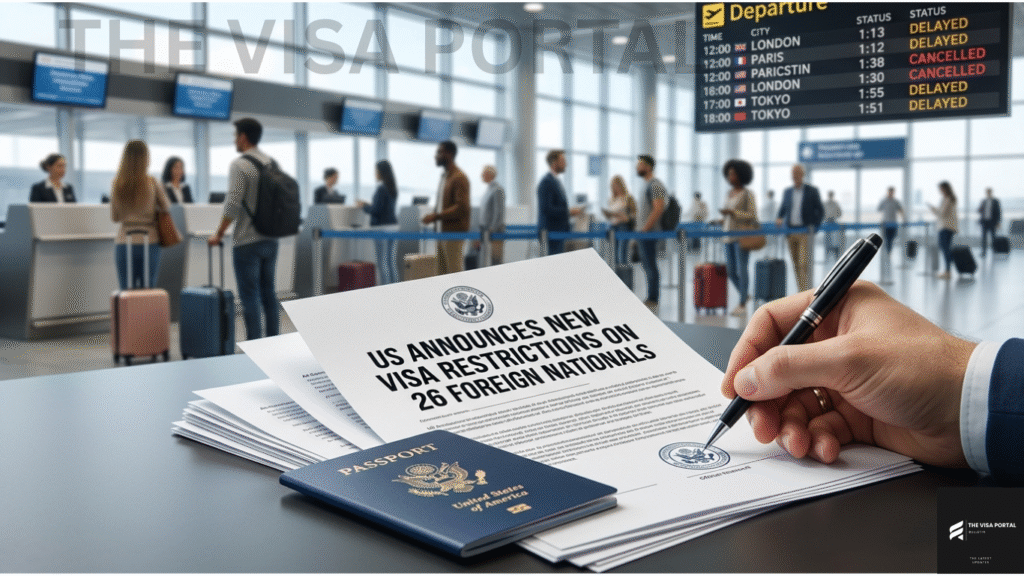
US ANNOUNCES NEW VISA RESTRICTIONS ON 26 FOREIGN NATIONALS

The United States has imposed a visa ban on 26 foreign nationals, which has caused controversy. These actions can influence diplomatic relations and set precedents for future US foreign policy strategies. Washington has a habit of turning immigration restrictions into influence, especially when it comes to issues like human rights abuses, corruption, election meddling, breaking sanctions, or threats to national security.  Visa bans aren’t new, but every time they happen, they worry travellers, businesses, students, and relatives of those who are affected. A lot of people want to know if these changes only affect the people identified or if they will also affect other transport systems and people who want to apply in the future. WHAT IS A US VISA BAN? A US visa ban is a legal restriction that prevents specific foreign nationals from entering the United States or obtaining a US visa, highlighting its targeted nature and scope. Such bans can result from US immigration laws, sanctions policies, or executive orders, highlighting the legal basis that helps the public understand their importance and fairness. The US government often issues visa bans when it thinks people were involved in: Corruption or misuse of public funds Human rights violations Organized crime activities Undermining democratic institutions Security threats Sanctions evasion Violence or political repression US EXPANDS VISA RESTRICTION POLICY According to the State Department, the new framework clarifies policy for policymakers and regional stakeholders by giving the US greater power to keep out people who don’t meet certain criteria, such as backing hostile governments or businesses with ties to the US. US officials say the targeted individuals planned, funded, or supported operations that put US interests in the Western Hemisphere at risk. Some of these attempts aim to control important resources, trade routes, regional infrastructure, or systems of sovereign government. Washington is taking a more proactive approach to limiting foreign influence, emphasizing the vital role of policy actions in maintaining regional stability. Policymakers and other key regional stakeholders should recognize their role in fostering a collective commitment. Immediate Family Members May Also Be Banned The State Department confirmed that the visa restrictions may not apply only to the targeted individuals. Immediate family members of those targeted, including spouses and dependents, may also become ineligible for travel to the United States, depending on the circumstances and enforcement procedures. This enforcement mechanism aims to bolster regional security by applying pressure on networks supporting foreign influence campaigns, reassuring international relations professionals that their ongoing efforts are essential in stabilizing the region. WHY U.S TOOK THIS STEP Officials stated that the new restrictions support several long-term national security goals, including: Protecting key trade routes and shipping access Preventing hostile control of strategic resources Securing critical infrastructure such as ports and transport systems Countering covert political influence operations Strengthening democratic institutions across the hemisphere Preserving regional stability and economic sovereignty Washington has increasingly warned about what it calls hybrid threats, where adversarial powers use economic leverage, political influence, infrastructure deals, and covert support networks to expand strategic control. 26 FOREIGN NATIONALS TARGETED In the most recent move, the United States banned the visas of 26 foreign people who were allegedly involved in operations that benefited unfriendly nations or organisations that operated in the Western Hemisphere. Officials stated the people are from other nations and are thought to be a part of larger foreign influence networks, even though they did not publicly reveal all identities in the initial announcement. Authorities also issued a warning that if other infractions are found, there may be more visa restrictions and associated actions. US ANNOUNCES STRONGER ENFORCEMENT STRATEGY The State Department described the initiative as part of a long-term framework designed to reinforce US leadership in the region while protecting both domestic and allied interests. Officials said the policy will be enforced using all available diplomatic and legal tools, signaling that Washington is prepared to take stronger action against those it believes undermine hemispheric security. The US also emphasized that the restrictions are consistent with broader efforts to stop external actors from gaining control over assets considered vital to regional cooperation and security. HOW THE NEW US VISA BAN AFFECTS TRAVELERS In most cases, a targeted visa ban on named individuals does not automatically affect ordinary citizens from the same country. Students, tourists, workers, and family-based applicants usually continue applying under normal visa procedures unless a broader country-wide restriction is separately announced. However, secondary effects can include: Increased scrutiny for some applicants Longer administrative processing Additional background checks Diplomatic tension affecting future visa policy FINAL THOUGHTS The US’s decision to limit visas for 26 foreigners shows that people are more worried about foreign influence and geopolitical competition in the Western Hemisphere. Washington is sending a clear message that it wants to protect national security and regional stability by making it harder to enter and giving law enforcement greater power to do their jobs. This policy expansion could be the start of bigger immigration and sanctions measures in the coming months, as officials have said that more moves may follow.

US ANNOUNCES NEW VISA RESTRICTIONS ON 26 FOREIGN NATIONALS Read More »

Visa news and Policy updates

uk confirms china featured

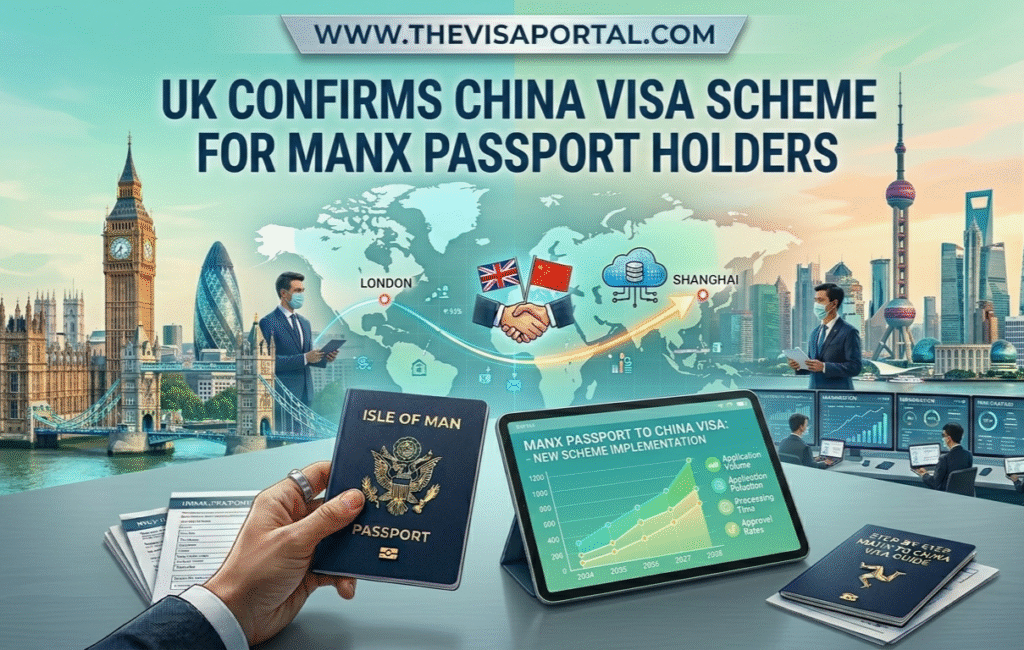
UK Confirms China Visa Scheme for Manx Passport Holders

The UK temporary China visa scheme has now been officially extended to include Isle of Man (Manx) passport holders, following recent incidents where several travellers were detained, questioned, or deported after arriving in China. The update comes after confusion over whether Manx passports qualified for China’s 30-day visa-free entry policy currently offered to British citizens. The UK government has now confirmed that holders of Crown Dependency variant passports, including Isle of Man passports, are eligible under the scheme. This choice should make things easier and more certain for people from the Isle of Man who are going to China for work, vacation, or to see family. WHY THE CHANGE WAS NEEDED Concerns about Manx passports arose after several travelers were denied entry to China. Last month, a woman told the BBC that she was turned away and sent back to the UK immediately because her Isle of Man passport didn’t meet China’s 30-day visa-free entry policy for British citizens. Another person, Niall Quiggin, said that when he arrived in China for employment in Yangzhou, he was held in a detention area for two hours. Later, he was given a temporary emergency entrance permit. The Isle of Man government and the UK’s FCDO have initiated formal discussions on these incidents. UNDERSTANDING MANX PASSPORTS An Isle of Man passport is given to eligible people living in the Isle of Man, a self-governing British Crown Dependency. Inside the passport, the nationality is written as British Citizen. However, the cover says British Passport – Isle of Man instead of United Kingdom of Great Britain and Northern Ireland. Because of this unique constitutional status, passport recognition and visa arrangements sometimes differ slightly from standard UK passport holders, depending on the destination country and the bilateral agreement in place. WHAT IS THE UK–CHINA VISA SCHEME? The UK–China visa facilitation arrangements are designed to simplify travel between the two countries. These schemes typically focus on: Easier access to short-term business visas Streamlined tourist visa processing Reduced documentation requirements for frequent travelers Faster application processing times The inclusion of Manx passports in such arrangements ensures that residents of the Isle of Man are not excluded from these simplified processes. OFFICIAL CONFIRMATION FROM THE UK GOVERNMENT The UK’s Foreign, Commonwealth and Development Office (FCDO) has now confirmed that Crown Dependency passports are covered under China’s visa-free entry arrangements. China had earlier announced that its 30-day visa-free entry scheme for UK nationals would continue until 31 December 2026. The latest clarification means this policy also applies to: Isle of Man passport holders Jersey passport holders Guernsey passport holders Other eligible Crown Dependency passport variants The Isle of Man government also said the Chinese embassy confirmed that border officials had been informed of the update. GOVERNMENT RESPONSE Treasury Minister Chris Thomas thanked those who highlighted the issue and welcomed the decision. He said, “he was pleased that holders of Isle of Man passports are now eligible for visa-free travel to China and hoped the clarification would provide greater certainty for people travelling for business, family, or leisure.” The Isle of Man government also confirmed it had worked closely with the UK’s FCDO to resolve the matter. IMPORTANT TRAVEL ADVICE Even though the scheme now applies to Manx passports, travellers should still: Carry a valid passport with sufficient validity Confirm airline boarding requirements before departure Keep hotel and return ticket details ready if requested Check the latest Chinese entry policies before travelling Entry decisions always remain subject to border authorities. FINAL THOUGHTS It is an extremely significant development that removes uncertainty for Manx travellers – China has expanded its visa-free entry scheme for Isle of Man passport holders. This official clarification comes after more difficult cases and should now allow easier access and fair treatment under the same travel policy as that given to UK citizens.For those in the Isle of Man, this means greater confidence in planning, simplified travel, and easier access to international destinations via passports.  FAQs (FREQUENTLY ASKED QUESTIONS) 1. Can Isle of Man passport holders now enter China without a visa? Yes, they are now eligible under China’s 30-day visa-free entry scheme for British citizens. 2. Why were some travellers refused earlier? Confusion over the wording and recognition of Manx passports caused problems at border control. 3. Does this also apply to other Crown Dependencies? Yes, Crown Dependency variant passports are included. 4. Is entry guaranteed now? No. Final entry decisions always remain with immigration authorities at the border.

UK Confirms China Visa Scheme for Manx Passport Holders Read More »

Visa news and Policy updates
russia visa free featured

RUSSIA VISA-FREE TRAVEL FOR SAUDI ARABIA 2026: BOOM IN AVIATION AND TOURISM

On May 11, 2023, Russia and Saudi Arabia announced that they would establish visa-free travel. The historic agreement allows up to 90 days of visa-free travel within one year for tourism, business, and family visits between the two countries.The one-opening travel revolution is likely to produce a tourist boost in 2026, double aviation growth, mean more hotel stays, and billions in new economic activity. The move will not only consolidate ties between the two states but also facilitate quick, easy, and inexpensive travel, industry specialists believe.  RUSSIA AND SAUDI ARABIA VISA-FREE TRAVEL STARTS MAY 11, 2026 According to official announcements, Saudi and Russian passport holders can now travel without applying for a visa in advance. Travelers can stay for up to 90 days continuously or through multiple visits during a calendar year. The policy applies mainly to: Tourism travel Business visits Family and social visits However, visas are still required for: Work and employment Study and education Permanent residency Hajj-related travel categories where applicable RUSSIA VISA-FREE TRAVEL 2026 BOOSTS TOURISM GROWTH The long visa process is one of the biggest problems for Saudi tourists. With Russia’s new visa-free travel policy, this problem will go away. To attract more visitors from the world’s fastest-growing travel market, Russia wants to make it easier for people to visit. Indicators from the UNWTO show that the number of people wanting to travel can rise by 20% to 35% in the first year or two after visas become easier to obtain. This means Russia might attract many Saudi tourists in the months after this strategy is put in place. We all know that time is of the essence, and the busy summer vacation booking season is sure to make people want to travel in that direction. RUSSIA VISA-FREE ENTRY RULES BALANCE SECURITY AND EASE Although Saudi citizens will no longer need a visa for short visits, standard immigration checks will still apply. Travelers are expected to present: Valid passports Return or onward travel tickets Hotel bookings or accommodation details, if requested Compliance with Russian border regulations This system balances easier travel access with proper security checks, giving passengers more confidence to book trips. RUSSIA AVIATION GROWTH 2026 DRIVEN BY VISA-FREE TRAVEL The new policy is expected to help the aviation industry right away. IATA says that removing visa restrictions can boost the number of air travellers on some lines by as much as 30%. This might cause: There are now more direct flights between Riyadh and Moscow. More links between Jeddah and Russia Added more seats to aeroplanes Better ways to get around through Gulf hubs Because there is more competition, tickets are more affordable. A higher number of passengers would make routes more profitable for planes and easier for travellers. RUSSIA-SAUDI ECONOMIC GROWTH FUELED BY TOURISM BOOM The benefits go beyond tourism. Easier travel often increases: Business meetings Trade events Investment visits Retail spending Hotel revenue Transport services Employment in tourism sectors Russia and Saudi Arabia already cooperate in areas such as energy, infrastructure, and investment. The visa-free policy can deepen those ties by making business travel faster and more efficient. RUSSIA SHIFTS TOWARDS GULF MARKETS IN GLOBAL TOURISM STRATEGY Russia has increasingly turned its attention to new travel markets rather than relying too much on tourists from the West. One of the new export markets is Saudi Arabia, where demand is skyrocketing, and people have a lot of money to spend. Russia can be less affected by changes in the global travel market and increase the variety of tourists it gets by focusing on people from the Gulf. SAUDI TRAVELERS EXPAND GLOBALLY UNDER VISION 2030 Saudi Arabia’s Vision 2030 changes have made it easier for people to communicate with each other around the world, increased disposable incomes, and made it easier for people to move around the world. Because of this, more and more people from Saudi Arabia are travelling abroad. Russia’s visa-free status helps this trend by making it easier for Saudi travellers to get to another significant destination. It also makes it easier for Saudi families and business travellers to make last-minute travel plans and choose from a wider range of destinations. RUSSIA STRATEGIC STAKES: REVENUE GROWTH AND GLOBAL POSITIONING Russia sees tourism as a major strategy to diversify its economy and increase revenue. By attracting high-spending tourists from abroad, especially from emerging markets such as Saudi Arabia and Russia, Russia aims to generate more foreign currency. This approach also ensures Russia remains competitive with its principal tourist rivals in Asia and Europe. Making the country easier to access for premium travelers further supports this goal. Ultimately, this strategy promotes sustained growth, broadens market penetration, and reduces reliance on a limited set of core source markets, positioning Russia strongly within the global tourism sector. SAUDI ARABIA STRATEGIC STAKES: MOBILITY AND GLOBAL INFLUENCE Under Vision 2030, Saudi Arabia is making it easier for its citizens to travel internationally, helping the country become more mobile worldwide. Better access to places like Russia makes it easier for people to engage with each other and share their cultures. The visa-free travel policy helps build stronger international connections and economic diplomacy. It also encourages Saudi tourists to go to places and markets that aren’t usually on their vacation list. The Kingdom’s larger ambition to become a top global business and tourism hub is evident in this increased mobility. Overall, it gives Saudi Arabia greater power in the world by strengthening travel and business ties. NEW RUSSIA-SAUDI TOURISM CORRIDOR OPENS IN 2026 Russia visa-free travel for Saudi Arabian citizens marks a major moment in international tourism development. By removing visa barriers, both countries are opening the door to: Higher visitor volumes More airline capacity Increased tourism revenue Stronger trade links Better international connectivity This new Russia-Saudi Arabia travel corridor could become one of the most significant growth routes of 2026. FINAL THOUGHTS Russia’s new visa-free travel policy for Saudi Arabia starting in May 2026 is one of the biggest travel developments of the year. It removes

RUSSIA VISA-FREE TRAVEL FOR SAUDI ARABIA 2026: BOOM IN AVIATION AND TOURISM Read More »

Visa news and Policy updates
american turns to irish featured

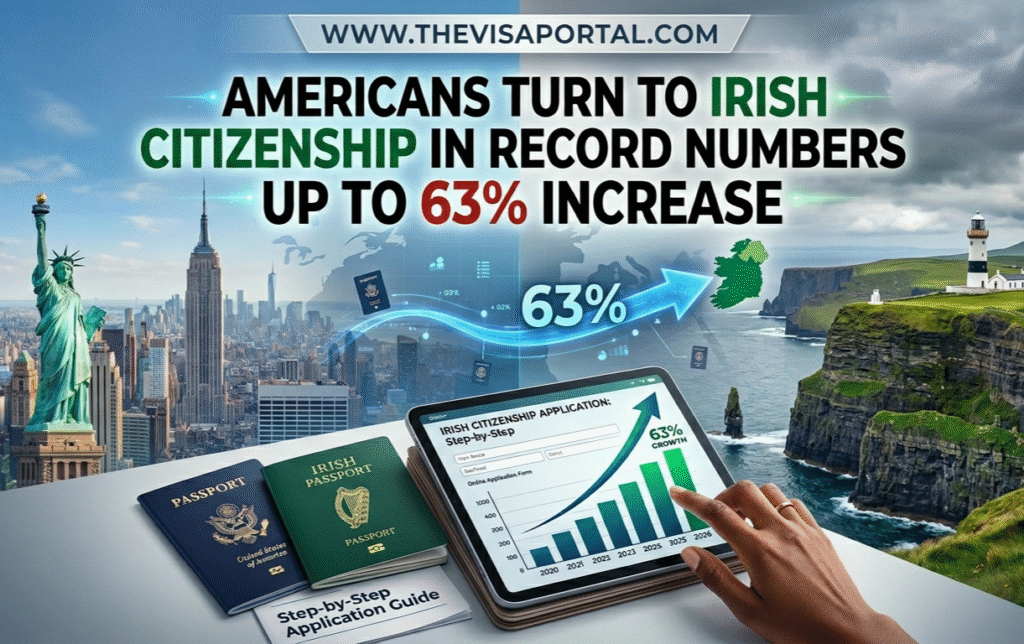
AMERICANS TURN TO IRISH CITIZENSHIP IN RECORD NUMBERS, UPTO 63%

Over the past few years, many people in the U.S. have been interested in obtaining Irish citizenship.Americans turn to Irish citizenship in record numbers. According to figures, the number of applications from Americans increased by about 63%, reflecting a growing trend of reconnecting with European roots while also exploring new global opportunities. This surge is not just a statistical spike—it highlights deeper social, political, and economic motivations shaping modern migration patterns. RECORD RISE IN CITIZENSHIP APPLICATIONS Data recently released from the official source shows a huge rise in U.S. applications to Ireland’s Foreign Births Register (FBR), the route that permits those with Irish parents or grandparents to acquire citizenship. The number of applications jumped from 11,601 in 2024 to 18,910 in 2025, a year-on-year rise of 63% and the highest figure since digital records began in 2013. However, Ireland is still processing a high number of applications. Approximately 40,250 citizenship certificates were granted in the same window, indicating that for the vast majority of applicants, once required documentation is provided applications are successfully processed. It also indicates that Ireland has improved its processing system to meet rising worldwide demand. WHY ARE MORE AMERICANS APPLYING FOR IRISH CITIZENSHIP? The primary reason for this surge is the excitement around citizenship through ancestry. Thanks to historical migration, millions of Americans have Irish roots—and that means they’re entitled to citizenship by descent. As more people discover this opportunity, pursuing a second passport has become an increasingly popular adventure.At the same time, uncertainty in the global landscape leads many to seek a “plan B” passport, choosing backup citizenship that provides security and flexibility. In a rapidly evolving world, citizens of EU nations like Ireland enjoy attractive benefits: they freely move, reside, and work across 27 (soon to be 28) European countries. IRELAND’S APPEAL AS A SECOND CITIZENSHIP Ireland offers Americans second citizenship by heritage, granting EU benefits. Many seek citizenship for family connections and long-term advantages. EU access allows Irish citizens to live, work, and travel freely across all 27 EU member states. Ireland is also attractive to foreign students due to its English language, strong economy, high quality of life, and the presence of global companies offering jobs. People who are American can usually keep their U.S. passport and become Irish citizens, which is another reason why dual citizenship is sigAmerican citizens can usually keep their U.S. passport and gain Irish citizenship, making dual citizenship significant. Irish citizenship offers families access to education, health care, travel, and connections with Europe. BROADER GLOBAL TREND IN CITIZENSHIP APPLICATIONS The increase in Irish applications is part of a global trend. USCIS data shows U.S. citizenship applications from the UK rose by 42% in 2025, as more Americans seek to live abroad and gain residency outside America.While the precise number of applicants who will ultimately go abroad remains uncertain, migration researchers confirm that the demand for international backup plans continues to rise. Migration and Emerging Patterns Alongside citizenship applications, actual movement is also rising: Around 9,600 Americans moved to Ireland in 2025, more than double the previous year. A small but growing number of U.S. citizens—94 applicants in 2025—sought asylum in Ireland, up from 22 the year before. Experts suggest that political concerns, including issues around immigration enforcement and social policy, are contributing to these shifts. IRELAND AS A STRATEGIC “PLAN B” DESTINATION Ireland is becoming a popular second passport option for Americans because many people can apply through their Irish family background. It is also part of the European Union, which gives citizens extra travel, work, and living rights in Europe. Experts say this trend may continue because more people want a backup plan in case of uncertainty in the world. They want a second citizenship for safety, freedom, and more opportunities. Ireland is seen as a good choice because it has strong connections with people of Irish descent, access to European countries, and a stable government. This makes it a practical and reliable option for those thinking about dual citizenship. Here is the source of the idea of this information. FINAL THOUGHTS The 63% surge in American applications for Irish citizenship reflects more than just a legal process—it signals a broader transformation in how people view identity, mobility, and security. With millions eligible through ancestry and growing global uncertainty, Ireland is increasingly seen as a gateway to Europe and a reliable “plan B” for U.S. citizens seeking flexibility in an evolving world. FAQs (FREQUENTLY ASKED QUESTIONS) 1. Why are more Americans applying for Irish citizenship? More Americans are applying due to Irish ancestry eligibility, rising interest in EU benefits, and a desire for a “Plan B” passport for greater global security and freedom. 2. What is meant by a “Plan B” passport? A “Plan B” passport means having a second citizenship as a backup option for travel, work, or relocation in case of political or global uncertainty. 3. Is Irish citizenship only based on ancestry? No, it can also be obtained through naturalisation, but most American applicants apply through Irish ancestry (parents or grandparents).

AMERICANS TURN TO IRISH CITIZENSHIP IN RECORD NUMBERS, UPTO 63% Read More »

Visa news and Policy updates
canada joins 1

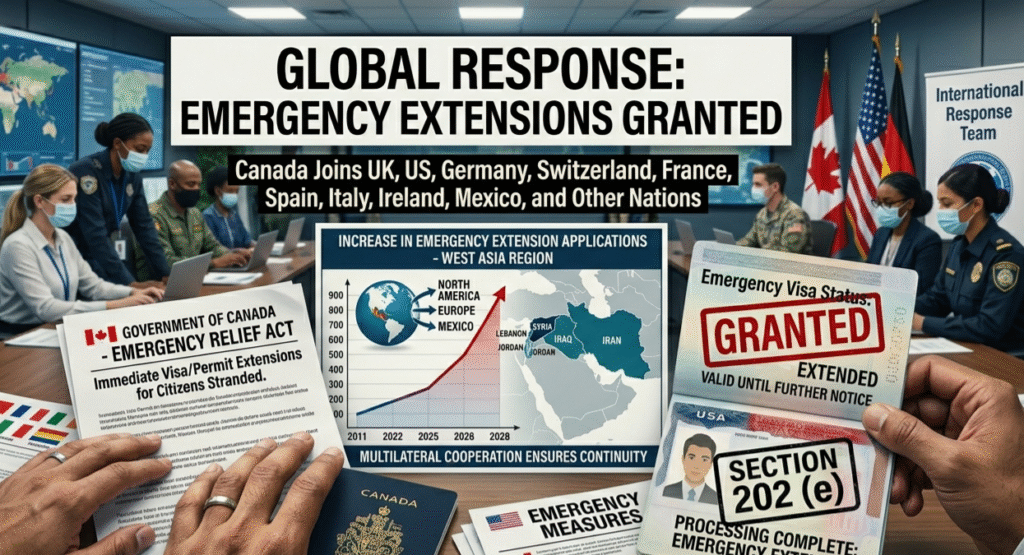
Canada Joins UK, US, Germany, Switzerland, France, Spain, Italy, Ireland, Mexico and Other Countries in Granting Emergency Extensions to Citizens Stranded in West Asia and Waving Visa Overstay Fines for Travellers Worldwide as Middle East Crisis Disrupts Global Travel

The ongoing crisis in West Asia is causing major disruptions to international travel routes, forcing airlines to halt operations in some of the world’s busiest air corridors, cancel flights, or reroute services. Thus, thousands of travellers from Canada, the United Kingdom, the United States, Germany, Switzerland, France, Spain, Italy, Ireland, Mexico, and many other nations have become stranded in the Gulf and neighbouring countries. Several governments and immigration authorities have implemented consular support measures, in addition to emergency visa extensions and penalty waivers, to protect travellers who become stranded as a result. These short-term rules are meant to protect visitors who stay longer than their visas allow, even when they can’t control it, from being punished. WHAT IS CAUSING MAJOR TRAVEL DELAYS? The Middle East plays a major role in international aviation. Europe, Asia, Africa, and North America are accessible via several major hubs, including Dubai, Doha, Abu Dhabi, Riyadh, and Kuwait. When regional tensions escalate and airspace is restricted, the consequences are far-reaching. Currently, a lot of travellers are dealing with: Flight delays or cancellations Unexpected route modifications Missed planes that connected While waiting for the exits, visitation visas that have expired Having trouble locating substitute tickets There aren’t many hotels available for extended stays. People who use public transportation, students, work travellers, and tourists have been the most affected. WHO IS FACING MAJOR TRAVEL DELAYS RIGHT NOW? The crisis has impacted people from around the world, including citizens of: Canada United Kingdom United States Germany Switzerland France Spain Italy Ireland Mexico India Australia South Africa Many Asian and European nations Because Gulf airports are major transit centers, even passengers travelling between unrelated destinations have faced delays. CANADA AND OTHER COUNTRIES RESPOND Canada has joined the global response by urging citizens to stay in contact with embassies and follow emergency travel updates. Similar support measures have also been introduced by the UK, US, Germany, France, Switzerland, Spain, Ireland, and others. CANADA PROVIDES AUTOMATIC STAY PROTECTION DURING TRAVEL CRISIS Canada has become one of the most organized responders by offering emergency extensions through its implied status system. Travellers who apply before their visa expires can legally remain in Canada until a final decision is made. This removes the risk of fines or unlawful presence while giving stranded passengers peace of mind. Canada has also supported citizens abroad through repatriation planning and coordinated return routes. Key Measures in Canada Visa Support: Implied Status Overstay Fines: Waived Citizen Support: Mass Repatriation Application Method: IRCC Portal Current Status: Ongoing GERMANY MAINTAINS LEGAL STABILITY FOR TRAVELLERS Travellers can stay in Germany legally for as long as they want as long as they apply before their visa expires, thanks to legal tools like Fiktionswirkung and EU Visa Code Article 33. German officials are also working with EU partners on return flights and aid for the area. Key Measures in Germany Visa Support: EU Article 33 Overstay Fines: Waived Citizen Support: EU Repatriation Application Method: Local Authority Current Status: Ongoing FRANCE STRENGTHENS EMBASSY AND IMMIGRATION SUPPORT France has implemented emergency protections under EU immigration rules while expanding embassy assistance services. French citizens abroad are receiving travel document support, while affected travellers inside France may receive penalty-free extensions. Key Measures in France Visa Support: EU Article 33 Overstay Fines: Waived Citizen Support: Embassy Coordination Application Method: Immigration Office Current Status: Ongoing ITALY USES EUROPEAN COOPERATION FOR RELIEF Italy has relied on strong coordination within the European Union to support tourists affected by the conflict in the Middle East and the ongoing flight delays. Travellers who are unable to leave on time may be allowed temporary visa extensions through EU immigration frameworks, without the penalty of an overstay. Italian authorities are also cooperating closely with other nation-states, many of which already have their own repatriation flights in the works. By establishing a system that enables quicker response times and resource-sharing during emergencies. Italy has regional cooperation, and it is using them to defend both its residents and foreigners while they await this period of travel difficulties. Key Measures in France Visa Support: EU Article 33 Overstay Fines: Waived Citizen Support: EU Flights Application Method: Provincial Offices Current Status: Ongoing UNITED KINGDOM PROVIDES FAST LEGAL PROTECTION The United Kingdom has activated its Exceptional Assurance system for travellers unable to leave because of flight cancellations or regional instability. This prevents visitors from being considered overstayers when delays are outside their control. British citizens stranded overseas are also receiving embassy guidance and evacuation support. Key Measures in the UK Visa Support: Exceptional Assurance Overstay Fines: Fully Waived Citizen Support: Evacuation Corridors Application Method: UKVI Contact Current Status: Ongoing UNITED STATES OFFERS FLEXIBLE EMERGENCY RELIEF The U.S. has provided immigration relief through Satisfactory Departure provisions and visa extension pathways. If you are unable to leave within the time frame, eligible visitors can remain in Australia temporarily with no penalty.Embassies have also helped with travel arrangements for U.S. citizens and offered assistance in emergencies abroad, Gonzalez said. Key Measures in the United States Visa Support: Satisfactory Departure / I-539 Overstay Fines: Waived (Case-Based) Citizen Support: Embassy Assistance Application Method: CBP / USCIS Current Status: Ongoing SWITZERLAND USES DIGITAL SYSTEMS FOR QUICK RELIEF Switzerland has launched an instant digital initiative to assist those impacted by flight cancellations and the Middle East crisis. Eligible visitors can apply for urgent visa extensions with less paperwork and expedited processing through online immigration systems. This helps stranded passengers maintain legal status without unnecessary delays or penalties. Swiss citizens have also stepped up consular assistance at major transit hubs to assist them while away from home. By combining technology with on-ground assistance, Switzerland is making crisis travel management smoother and more effective. Key Measures in Switzerland Visa Support: Digital Extension Overstay Fines: Waived Citizen Support: Consular Desks Application Method: Online Current Status: Ongoing SPAIN RESPONDS QUICKLY TO TRAVEL DISRUPTIONS Spain has immediately changed its travel rules in response to the situation in the Middle East, which has affected many parts of the world. All affected visitors have been granted

Canada Joins UK, US, Germany, Switzerland, France, Spain, Italy, Ireland, Mexico and Other Countries in Granting Emergency Extensions to Citizens Stranded in West Asia and Waving Visa Overstay Fines for Travellers Worldwide as Middle East Crisis Disrupts Global Travel Read More »

Visa news and Policy updates
finland joins featured

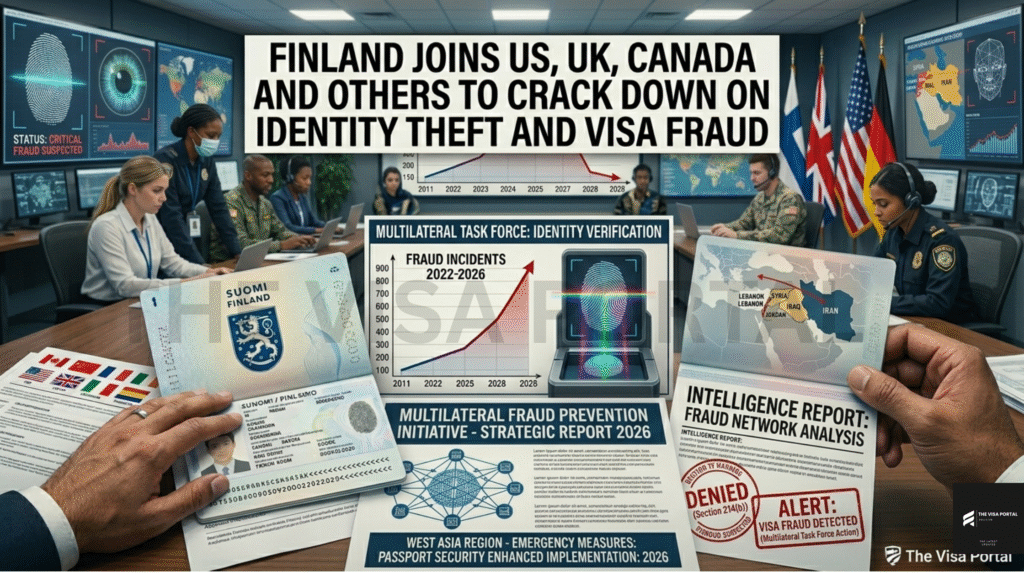
FINLAND JOINS US, UK, CANADA AND OTHERS TO CRACK DOWN ON IDENTITY THEFT AND VISA FRAUD

According to reports, as part of the international trend to prevent identity theft and unauthorized travel activities, Finland has formed a partnership with several nations. These include the United States, the UK, Germany, Canada, and France, as well as relatively developed countries such as the Netherlands and Estonia. In addition, major Southern Hemisphere players like Argentina, Mexico, and Brazil are participating. These nations now use strengthened identity verification systems and tightened visa issuance processes. The move reflects a wider global shift toward securing borders through centralized and digitized identity management systems. RISING CONCERNS OVER IDENTITY FRAUD AND VISA MISUSE For many years, governments in Europe and the Americas have faced significant challenges related to identity theft, fraud, passport forgery, drug-related issues, and the misuse of travel visas. In response, many countries have increased their focus on verifying identities before allowing individuals to enter or travel within their borders, aiming to reduce the risk of unauthorized individuals using synthetic identities to commit entry or travel violations. Finland is joining this broader initiative, signaling its commitment to updating border security standards in line with international norms. Authorities are concentrating on addressing vulnerabilities in travel systems while striving to facilitate hassle-free processing for genuine travelers. HOW COUNTRIES ARE RESPONDING TO IDENTITY FRAUD AND VISA MISUSE Governments around the world are introducing stricter passport controls, centralized identity systems, and stronger verification measures to combat rising fraud risks and unauthorized visa use. Many countries are also investing in biometric technology and digital identity tools to improve security while making travel document processing faster and more consistent. FINLAND LAUNCHES CENTRAL PASSPORT REFORM FOR FASTER AND SAFER SERVICES Finland is taking steps to make reforms permanent by granting the Finnish Foreign Ministry control over passport and identity decisions. However, local offices will still handle the processing of applications and the collection of biometrics.  The goal of these changes is to alleviate the stress caused by high demand and stringent constitutional requirements. In addition to enhancing national security, this reform aims to improve Finland’s public service delivery system. It might also enable Finland to create a more secure identity wallet in the future by reducing the number of documents needed for identification. Benefits: Faster approvals and fewer delays Stronger legal compliance and security control Reduced workload at embassies Supports future EU digital identity systems GERMANY STRENGTHENS SECURITY WITH CENTRAL PASSPORT OVERSIGHT Germany is giving more power to the central government over passports and IDs to deal with cyber risks, identity theft, and the rise in international travel. Embassies will be where people go to apply, and domestic systems will handle approvals. This method makes things safer and helps the EU’s identity balance grow. Benefits: Improved fraud prevention Consistent decision-making worldwide Fewer inconsistencies at the embassy level Support for alignment with EU identity policies SPAIN BUILDS A UNIFIED AND FASTER PASSPORT NETWORK Spain is working to upgrade its passport and identification systems by centralizing approvals and processing applications from abroad at its embassies and consulates. It supports Spain’s alignment with broader European digital identity goals, which focus on enhancing security, improving user experience, and ensuring interoperability with digital identity systems of other EU member states. Consequently, overseas tourists and citizens in Spain can expect faster, more streamlined, and more reliable passport services. Benefits: Reduced duplication Faster services abroad Stronger EU alignment Improved cross-border verification CANADA UPGRADES PASSPORT PROCESSING FOR CITIZENS ABROAD Canada continues strengthening its centralised passport system to manage growing global demand. Applications are collected abroad, while approvals are handled by federal authorities, ensuring coordination and consistency. Benefits: Improved efficiency Better support for citizens overseas Scalable identity system Uniform processing standards MEXICO IMPROVES PASSPORT SERVICES WITH CENTRAL AUTHORITY Mexico is streamlining passport issuance by centralising authority within its Foreign Ministry while using consulates as service access points. This helps improve coordination, speed up processing, and better serve millions of citizens living abroad. Benefits: Faster and coordinated processing Better service for overseas citizens Lower administrative complexity Improved identity management UNITED STATES KEEPS STRONG CENTRAL CONTROL OVER PASSPORT ISSUANCE The United States manages its passport system centrally through the Department of State. Embassies accept applications, but approval remains central to ensure identity checks. This system processes millions of passport requests quickly, significantly reduces the risk of fraud, and maintains consistency worldwide. Benefits:  Strong national security oversight Uniform processing worldwide Efficient handling of large volumes Reduced risks of fraud and misuse NETHERLANDS MOVES TOWARD A SMART DIGITAL IDENTITY MODEL The Netherlands is progressing towards a more sophisticated digital ID solution, centralising passport and identification approval processes under national authorities. Embassies and consulates support citizens abroad by gathering applications and biometric data. By implementing this approach, they reduce administrative delays, standardise procedures, and enhance identity verification standards. Additionally, it aligns with the long-term national agenda concerning reliable digital ID services. This results in increased speed, improved online systems, and consistent processing for citizens worldwide. Benefits:  Lower burden on missions abroad Consistent approvals Supports digital transition Encourages global adoption BRAZIL ENHANCES GLOBAL PASSPORT SERVICES THROUGH CENTRALISATION Brazil manages passport issuance centrally through federal authorities while embassies provide citizen access abroad. This ensures more reliable processing and stronger security for its large international population. Benefits: Strong oversight and security Efficient diaspora services Faster processing times Consistent decisions globally UNITED KINGDOM EXPANDS CENTRALISED PASSPORT MANAGEMENT WORLDWIDE The UK has a more centralised passport system that requires domestic authorities to make final decisions but relies on embassies to collect documents and biometrics.This method helps handle soaring demand, ensures faster approvals, and upholds uniform security requirements worldwide. Benefits: Central control over identity decisions Faster and more efficient approvals Stronger fraud prevention Ready for future digital ID integration  FRANCE USES CENTRAL CONTROL TO BALANCE SPEED AND SECURITY France relies on a centralised passport and identity system for oversight and efficiency. National authorities handle final approvals. Embassies and consulates manage applications and biometric collection abroad. This structure reduces errors, speeds up processing, and prevents fraud. France consistently handles high volumes of requests worldwide. Citizens benefit from faster, safer, and more reliable passport services. Benefits:  Faster approvals Strong national oversight Efficient

FINLAND JOINS US, UK, CANADA AND OTHERS TO CRACK DOWN ON IDENTITY THEFT AND VISA FRAUD Read More »

Visa news and Policy updates
spain 1500 euro (1)

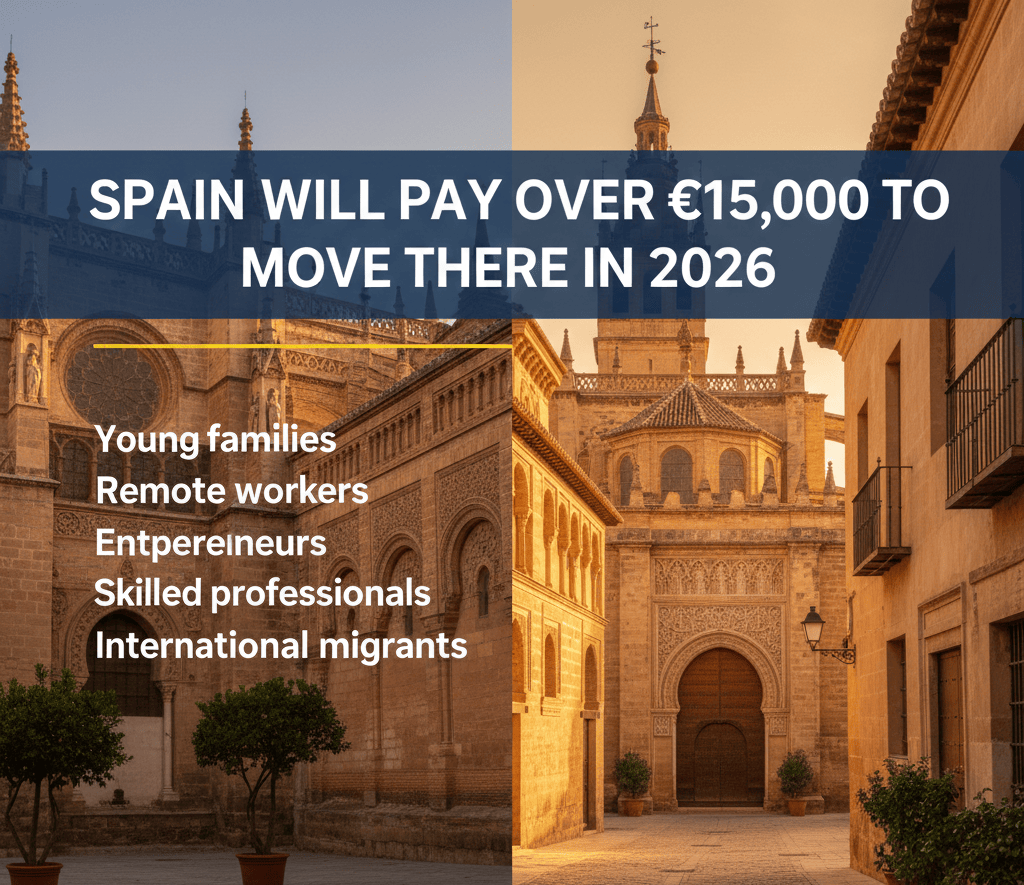
SPAIN WILL PAY €15,000 TO MOVE THERE IN 2026

The goal of these Spanish programs is to provide people with money, safety, and a peaceful European way of life at a time when many newcomers face strict rules and high living costs in other countries. COMPLETE GUIDE FOR PAKISTANI FAMILIES Do you wish to move to Europe? What if you got paid to move? In 2026, people who want to work from home and are ready to move with their families for at least two years can get up to €15,000. Those from Pakistan who want to apply should know that this is all the essential information about Spain’s relocation incentives for 2026. WHY IS SPAIN PAYING PEOPLE TO MOVE THERE? Like many other European countries, Spain is seeing a big drop in the number of people living in rural areas. As big cities like Madrid and Barcelona continue to grow, rural towns are losing people because birth rates are low, populations are getting older, and people are moving to places that are growing. To try to fight this trend, local and regional governments are giving money to: Young families Remote workers Entrepreneurs Skilled professionals International migrants The goal is simple: bring life back to rural Spain. HOW MUCH MONEY CAN YOU GET? The incentive amount varies by region and program, but in 2026, you may receive: Up to €15,000 per family €3,000–€5,000 per adult Additional bonuses per child Extra grants for starting a business Some areas also offer: Subsidized housing Rental assistance Tax reductions Free childcare support The total support package can sometimes exceed €15,000, depending on family size and project plans. AREAS THAT WILL PROVIDE RELOCATION BONUSES People know that the following Spanish regions provide paid relocation plans: Asturias The Principality of Asturias has been aggressively encouraging young families and digital nomads to move to rural areas. Money is offered for building new homes, running a company, and making changes to existing ones. The Galician The government gives families incentives to move to small towns in Galicia that are losing people. Families with kids can get even more benefits. León y Castilla This large autonomous community helps professionals and businesses who are going to rural areas with money. Aragón Some villages in Aragón give direct cash incentives and tax breaks to new residents who promise to stay for a long time. WHO CAN APPLY? Key Eligibility Requirements: Eligibility criteria vary, but most programs require: Legal right to reside in Spain (EU citizens or valid visa holders) Commitment to stay for 2–5 years Registration as a local resident (empadronamiento) Employment contract, remote income proof, or business plan Non-EU nationals must first secure an appropriate visa, such as: Spain Digital Nomad Visa Work Visa Self-Employment Visa Applications are expected to open around mid-September 2026, according to European media reports. CAN PAKISTANIS APPLY? Yes, but there is one important condition. Pakistani citizens must first get a Spanish Digital Nomad Visa or another valid resident status before they may apply for the grant. The cash help does not change the visa criteria. After getting legal residency in Spain, eligible remote workers can apply for the “Live in Ambroz” project’s relocation incentive. AVAILABLE JOBS Rural areas are particularly looking for: Healthcare professionals Teachers IT specialists Skilled tradespeople Hospitality workers Remote freelancers Entrepreneurs willing to open small businesses (cafés, shops, agricultural projects, tourism ventures) are highly encouraged. BENEFITS OF MOVING TO RURAL SPAIN In addition to cash benefits, you’ll also enjoy: Less expensive to live Affordable housing A peaceful way of life Landscapes in nature A strong sense of community Access to Spain’s public health care system Compared to crowded cities, living in rural Spain gives you a better balance between work and life. HOW TO APPLY? Step-by-step process: Find out more about the municipalities that are taking part. Look at the websites of the official regional governments. Check that you meet the prerequisites. If you need one, apply for a Spanish visa. Fill out an application for a relocation grant. When you get there, sign up as a resident. Always apply through official government portals to avoid scams. IS IT WORTH IT TO GO TO SPAIN FOR €15,000? The money is a good motivation to move, but it shouldn’t be the only one. Moving to another country takes a lot of planning, especially when it comes to work, language, health care, and fitting in. But if you work from home, own your own business, or want to live a quiet life in Europe with your family, Spain’s relocation plans in 2026 could be a great chance.

SPAIN WILL PAY €15,000 TO MOVE THERE IN 2026 Read More »

Visa news and Policy updates
gemini generated image eoasx7eoasx7eoas(1)

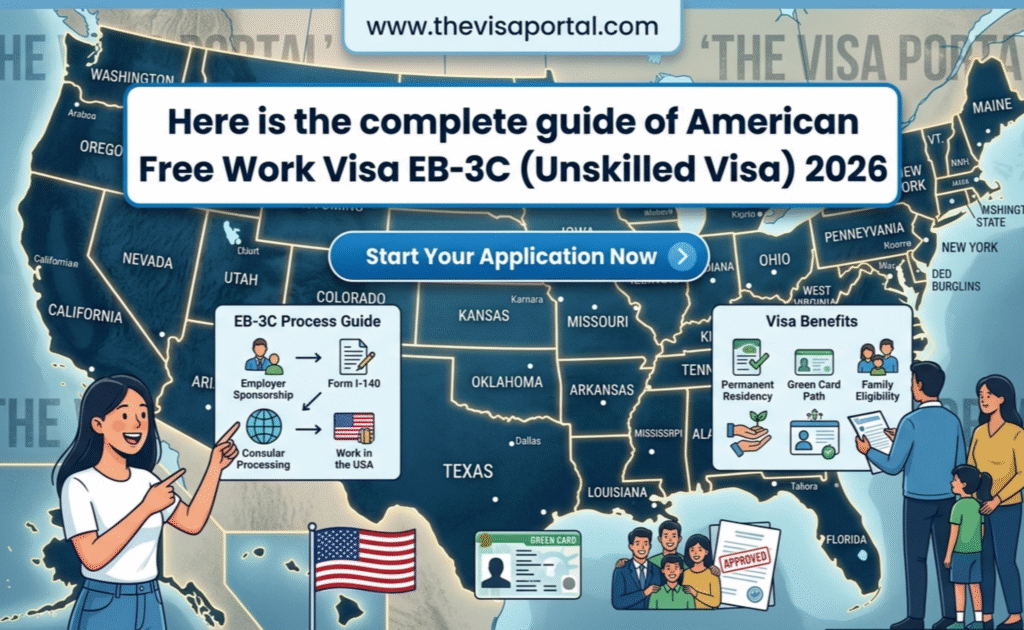
AMERICAN EB-3C FREE WORK VISA 2026:THE COMPLETE GUIDE

EB-3C WORK VISA The EB3C Visa is a US-based employment visa for workers who can perform duties that do not require more than 2 years of specialized training or experience. The appeal of such a visa lies in granting its holders lawful permanent residency status in the USA, also known as a green card. WHAT IS EB-3C UNSKILLED VISA? EB3C Visa, referred to as Other Workers in another context, is one of the easiest means for individuals from different nations to immigrate to the United States and get a U.S. Green Card through work. It is a perfect choice for individuals who wish to make their living in America but cannot boast a formal education and/or specific skills. The visa portal provides you the complete guidance for this just visit: www.thevisaportal.com This visa program is accessible to many people because it does not require any formal education. ADVANTAGES OF EB3C FREE WORK VISA (UNSKILLED VISA) Here are some of the key advantages of an EB-3C visa: If your application is accepted, you will receive a green card, which allows you to work freely in the USA. You do not have to be highly educated or knowledgeable about your field; just basic skills are sufficient to land the job. Spouses and unmarried children under 21 can accompany you as dependents on visas. Then, after a few years, you can apply for citizenship once you get the green card. REQUIREMENTS FOR EB3C VISA The basic requirements for applying an EB-3C Unskilled visa are as follows: You must have an offer of employment from a U.S. employer. It cannot be tied to more than two years of experience or training. This is a very good setting for an employer to demonstrate that there are no qualified U.S. workers available for that position. You should have sufficient qualifications and medical fitness. TYPES OF JOBS AVAILABLE EB3C unskilled jobs are usually in sectors where labor shortages exist. Common job roles include: STEP BY STEP APPLICATION PROCESS Step 1: Finding a U.S. Job Offer First, you need a job offer from an employer in the USA who will sponsor a visa. Step 2: PERM Labor Certification The employer seeks labor certification from the Department of Labor stating that there is no qualified worker in the area willing to take up the job. Step 3: Form I-140 Petition Filing of this immigrant petition is done by the employer on behalf of the applicant, after the PERM certification. Step 4: Priority Date Waiting Period Due to the high number of applications, you will have to wait until the priority date becomes current before you are evaluated. Step 5: Consular Processing or Adjustment of Status The applicant may request an adjustment of status if they are already in the United States.  To accomplish this, submit Form I-485 to USCIS. Form DS-260 must be submitted and processed by the consulate for those who are not in the United States.  They do this at a U.S. embassy or consulate back home. Step 6: Visa Interview at U.S. Embassy The U.S. embassy conducted a visa interview. REQUIRED DOCUMENTS Applicants should produce: PROCESSING TIME The EB-3C visa process can take time due to demand: Patience is essential, as this is a long-term immigration pathway. COST OF EB-3C VISA Although often advertised as a “free work visa,” the reality is: Employers usually cover major costs (PERM & petition) i-e $715 Applicants may pay for: IS EB-3C UNSKILLED VISA WORTH IT? Yes, the EB-3C visa is a life-altering opportunity for many. Even with low types of qualification, it is a lawful and secure way to stay in the USA. But it takes time, effort, and a strong employer sponsor. FINAL THOUGHTS One of the easiest ways to immigrate to America for a better career is through the American EB-3C Unskilled Work Visa. Although the process can be time-consuming, achieving United States permanent residency status is well worth it. If you are serious about getting into the U.S., your first step should be finding a real employer and being familiar with the whole process

AMERICAN EB-3C FREE WORK VISA 2026:THE COMPLETE GUIDE Read More »

Visa news and Policy updates

f 1 visa featured(1)

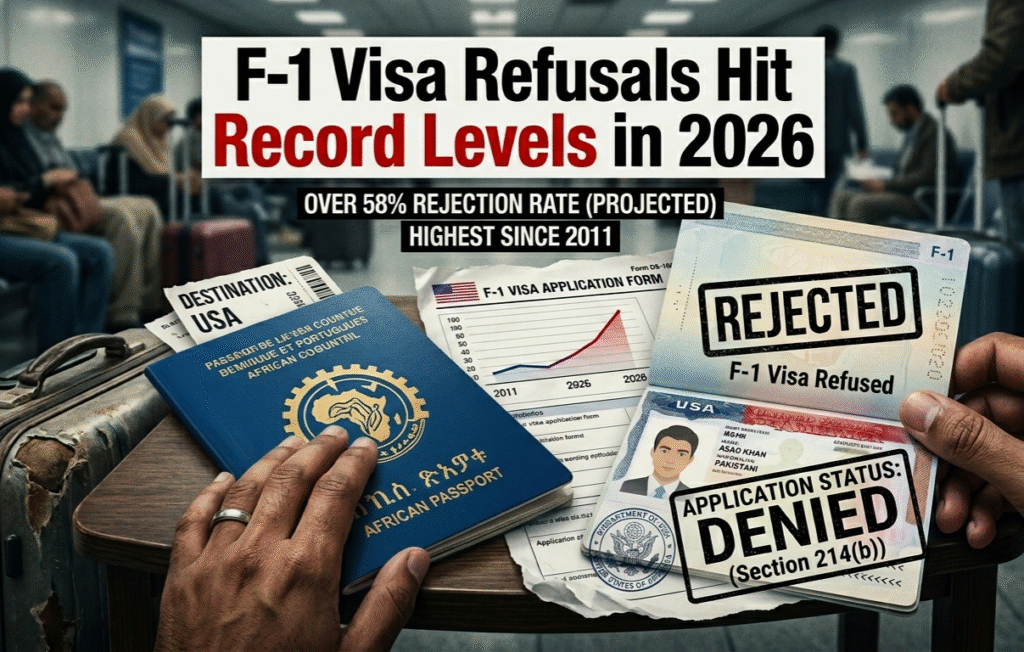
F-1 VISA REFUSALS HIT RECORD LEVELS IN 2026

F-1 Visa Refusals Hit Record High in a Decade USA F-1 student visa refusal rate hits the all-time high record of the history making it more difficult day-by-day. Here is why? The dream of studying in the USA was severely hit in 2026, when F-1 student visa refusals reached an all-time high, making it even more difficult for thousands of candidates from countries. What began as a sharp rise in 2025 has continued into 2026, showing that the issue is no longer temporary. It is not a short-term problem but an ongoing challenge that is reshaping international education through stricter scrutiny, changing U.S. immigration policies, and shifting global conditions. In some countries, visa refusals have reached shocking levels, exceeding 90%, raising serious concerns about fairness in the student visa system. Recently, data released shows that 2026 was one of the hardest years for student visa applicants: This sharp increase has directly contributed to declining international student enrollment in U.S. universities. Which Regions Were Most Affected? The rise in refusals has not been evenly spread. Some regions have been hit much harder than others: Africa Africa had the highest overall rejection rates. In 2025, approximately 64% of student visa applicants from African nations were refused entry. The number is a big jump from 43% in 2015, and even higher than a year earlier. In the most extreme instances, countries such as Sierra Leone and Somalia had refusal rates above 90%. South Asia (Pakistan, India, Nepal) Refusals also soared in South Asia. India, for instance, which had long been the largest single source of international students to the United States, saw its rejection rate rise in two years from 36 percent in 2023 to 61 percent in 2025 — evidence of how swiftly things have turned. Middle East Middle Eastern applicants were also looked at more closely, which led to higher rejection rates across the area. South America and Europe (Less Affected) South America, however, has improved from 31% in 2022 and 22% in 2025. The most stable region was Europe, with a rejection rate of 9% over the past 10 years. Why Did F-1 Visa Refusals Increase in 2026? Several key factors explain this dramatic rise: 1. Stricter “Non-Immigrant Intent” Checks (Section 214(b)) Visa officers are now more strict in ensuring that students intend to return home after their studies. If applicants fail to prove strong ties—such as family, job prospects, or assets—the visa is often denied. 2. More Security and Social Media Monitoring In 2026, the U.S. began implementing stricter check-out procedures that included examining applicants’ online presence and social media use. This provided an additional level of scrutiny to the process. 3. Financial Proof Requirements Students must explicitly show that they can afford both tuition and living expenses. Fragile or faint monetary documentation has become a major reason for disapproval. 4. Inconsistent or Poor Interview Performance If answers are unclear or they lack confidence in their visa interviews, even strong applicants are turning up empty-handed. The interview is a big factor for officers in deciding who’s credible and not. 5. Policy Changes and Political Environment Stricter immigration policies, visa suspensions for certain countries, and geopolitical tensions have also contributed to rising refusals. 6. Fraud Prevention Crackdowns With concerns regarding forged documentation, students with no genuine purpose, and improper use of research visas rising, authorities are becoming increasingly cautious. Concerns About Merit-Based Visa Approvals Many experts still criticise the current system because nationality seems to have a bigger impact on immigration decisions than individual merit.Some countries have more refusals than others, which means that students from certain areas may have a harder time getting in, no matter how much money they have or how well they do in school.This has led to what many call a “high-refusal tier,” which mostly affects countries in the Global South. Position of the Government According to government officials, all visa applications are reviewed individually, as is required by law. They argue that visa issuance is not an obligation and should be based on national security priorities. Authorities also say that all applications are carefully checked based on documents, background information, and eligibility. Decline in Visa Approvals It is evident from governmental statistics that there was 35.6% reduction in the number of approved student visas from summer 2024 to summer 2025, which has echoed into 2026. It is not only about getting appointments, but also about rising rejection rates. Economic Impact on U.S. Universities There will be fewer international students, harming institutions’ reputations in different countries. As expected, U.S. universities will face revenue losses of about $3 billion from their students. Beyond financial losses, the decline also impacts:  Recommendations for Improvement There are several suggestions on how to fix the situation provided in the report: Implementing these measures can help build students’ trust in the procedure. What to Expect in the Future? Although the visa climate should remain rigid, there will likely be policy changes. There are several suggestions on how to fix the situation provided in the report: Implementing these measures can help build students’ trust in the procedure. down the line. Some proposals, such as removing the “intent to return” rule, may be considered and potentially implemented, but again, it is all dependent on whether or not it comes to pass. Students should assume that: • A high degree of visa scrutiny will persist. •Documentation standards will become ever more stringent. •There will be a rise in demand regarding preparation. Final Thought The admission process has grown even stricter, with F-1 student visa refusals rising into 2026. For most students, studying in America is still possible as it was before; however, they will likely need better preparation, including strong documentation and a clear intent to study. For several applicants, 2026 will be successful not only via university selection but also through smart visa planning.

F-1 VISA REFUSALS HIT RECORD LEVELS IN 2026 Read More »

Visa news and Policy updates
turkey green 3(1)

TURKEY GREEN PASSPORT WITH SCHENGEN ACCESS

WHAT IS TURKEY’S GREEN PASSPORT THAT GRANTS SCHENGEN ACCESS Turkey provides its citizens with an additional advantage when travelling through the Green Passport. The Green Passport is a special type of passport issued to certain applicants that allows them to enter the Schengen Area without a visa. In contrast, ordinary Turkish passports do not grant their holders such freedom. Moreover, Turkey’s Citizenship by Investment program has been gaining immense popularity worldwide. After reducing the amount of real estate investment from one million dollars to two hundred fifty thousand dollars in 2018, almost forty thousand investors have obtained Turkish citizenship, generating fifteen billion dollars for the Turkish economy. Now, the minimum investment required is $400,000. While regular Turkish passports allow travel to over 100 countries without a visa, they don’t cover Schengen countries. The Green Passport stands out because it allows entry into Europe without a visa. WHAT IS TURKISH GREEN PASSPORT? The Turkish Green Passport (Hususi Damgalı Passport) is an exclusive travel document issued under Turkish law, available to a select number of citizens who meet specified professional or economic requirements. The Green Passport provides visa-free access to the Schengen Area for short stays (up to 90 days within any 180 days), as well as to approximately 150–160 other countries worldwide, unlike the standard Turkish (maroon) passport, which requires a visa for Schengen countries. Typically, valid for 5 years, it provides much greater international mobility and is often very valuable to frequent travelers and business travelers. WHATS MAKES THE GREEN PASSPORT SPECIAL? People generally talk about Turkish citizenship advantages like: Quick processing time Opportunity to apply for US E-1 and E-2 visas Enhanced travel access to numerous nations But there’s a big advantage that most people don’t see: Visa-free travel to the Schengen Area (Europe) This is very helpful for investors, business owners, and professionals who travel a lot to Europe. WHO IS ELIGIBLE FOR THIS PASSPORT? The Green Passport is not available to all citizens. It is issued only to specific categories: Government Officials Senior civil servants (Grade 1, 2, or 3) Typically require 15+ years of service and education Politicians and Public Figures Members of parliament Former ministers Mayors during their term Retired Officials Retired civil servants who previously held qualifying positions retain eligibility Family Members Spouse Children under 25 (if dependent) Exporters and Business Professionals Turkey introduced a special pathway for business owners: Company must achieve a minimum of $500,000 in annual exports Average calculated over 3 years Owners, directors, or employees may qualify HOW FOREIGN INVESTORS CAN GET IT? Foreigners cannot directly apply for the Green Passport. However, there is an indirect route: Step-by-Step Pathway: Obtain Turkish citizenship (e.g., investment program) Start or acquire a Turkish export company Maintain exports of at least $500,000 annually for 3 years Apply through the Exporters’ Union Receive approval from the Ministry of Interior Once approved, the passport is usually issued within 4–8 weeks. VALIDITY AND RENEWAL Valid for up to 5 years Renewable if eligibility conditions remain Linked to employment, status, or business activity COUNTRIES YOU CAN VISIT Green Passport holders can travel to: Schengen countries (Germany, France, Spain, etc.) Asian countries like China Middle Eastern countries like UAE Many others globally Overall, access extends to 150–160+ destinations. FROM CITIZENSHIP TO GREEN PASSPORT: THE EXPORT ROUTE EXPLAINED After obtaining Turkish citizenship through real estate investment (minimum $400,000), the investor receives a standard passport. The Green Passport is not included and must be earned through a separate export-based process. To qualify, the investor must establish or acquire a Turkish company and generate at least $500,000 in annual exports for three consecutive years. According to advisory sources, this is a strict requirement. Once completed, eligibility is confirmed by the Exporters’ Union, followed by final approval from the Ministry of Interior, after which the passport is usually issued within 4–8 weeks. Each application is reviewed individually, and export performance is carefully verified before approval. RECENT EU-TURKEY DEVELOPMENTS (2025-26) Several recent developments have improved Turkey’s position in Europe: SEPA Integration Proposal The EU has proposed including Turkey in the Single Euro Payments Area (SEPA), which would simplify and reduce the cost of euro transfers. Industrial Policy Alignment New EU proposals may allow Turkish goods to be treated similarly to EU-origin products in certain procurement sectors, thanks to existing trade agreements. Schengen Cascade Visa System Turkish citizens can now benefit from progressively longer visas: First visas → short-term After compliance → 1-year, 3-year, and 5-year multi-entry visas Although not automatic, this system improves overall mobility for Turkish nationals. IS THIS GREEN PASSPORT RIGHT FOR YOU? That will depend on who you are: ✅ Best choice for those who own businesses and/or export goods ✅ Suitable for regular travelers heading to Europe ❌ Not for you if you don’t wish to put much effort into this process and would like to travel freely It’s a long-term strategy, not a quick solution. FINAL THOUGHTS Turkey’s Green Passport is a powerful travel document, but it’s only available to some Turkish citizens. It allows them to enter the Schengen Area without a visa, but this doesn’t work for other Turkish passport holders. Although the Golden Visa system was primarily created for government officials, with the launch of an export-based pathway, entrepreneurs and investors were able to open their doors. But it takes time to obtain, plan, and engage in real economic activity, so while it is a strategic advantage, it is not a shortcut.

TURKEY GREEN PASSPORT WITH SCHENGEN ACCESS Read More »

Visa news and Policy updates