F-1 Visa Refusals Hit Record High in a Decade
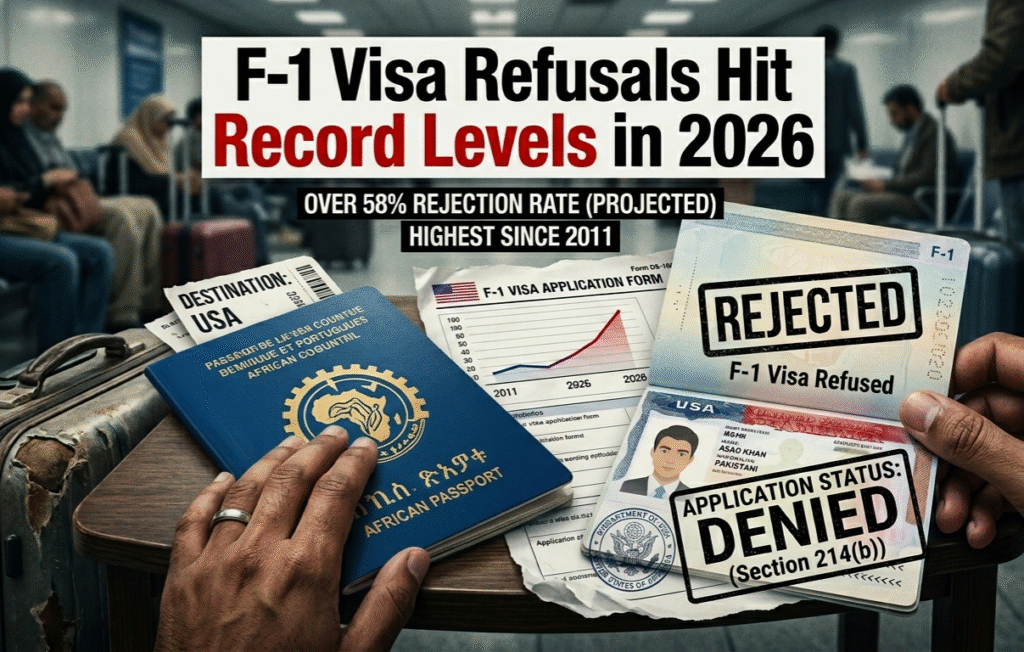
USA F-1 student visa refusal rate hits the all-time high record of the history making it more difficult day-by-day. Here is why?
The dream of studying in the USA was severely hit in 2026, when F-1 student visa refusals reached an all-time high, making it even more difficult for thousands of candidates from countries.
What began as a sharp rise in 2025 has continued into 2026, showing that the issue is no longer temporary. It is not a short-term problem but an ongoing challenge that is reshaping international education through stricter scrutiny, changing U.S. immigration policies, and shifting global conditions. In some countries, visa refusals have reached shocking levels, exceeding 90%, raising serious concerns about fairness in the student visa system.
Recently, data released shows that 2026 was one of the hardest years for student visa applicants:
- Global F-1 visa refusal rates approached 35%, the highest levels in a decade
- Some reports suggest refusal rates reached as high 41% in new fiscal data
- Refusal rates for Indian students skyrocketed from 36% in 2023 to nearly 61% in 2024.
- For African applicants, rejections averaged 64%, with rates for some countries exceeding 90%
This sharp increase has directly contributed to declining international student enrollment in U.S. universities.
Which Regions Were Most Affected?
The rise in refusals has not been evenly spread. Some regions have been hit much harder than others:
Africa
Africa had the highest overall rejection rates. In 2025, approximately 64% of student visa applicants from African nations were refused entry. The number is a big jump from 43% in 2015, and even higher than a year earlier. In the most extreme instances, countries such as Sierra Leone and Somalia had refusal rates above 90%.
South Asia (Pakistan, India, Nepal)
Refusals also soared in South Asia. India, for instance, which had long been the largest single source of international students to the United States, saw its rejection rate rise in two years from 36 percent in 2023 to 61 percent in 2025 — evidence of how swiftly things have turned.
Middle East
Middle Eastern applicants were also looked at more closely, which led to higher rejection rates across the area.
South America and Europe (Less Affected)
South America, however, has improved from 31% in 2022 and 22% in 2025. The most stable region was Europe, with a rejection rate of 9% over the past 10 years.
Why Did F-1 Visa Refusals Increase in 2026?
Several key factors explain this dramatic rise:
1. Stricter “Non-Immigrant Intent” Checks (Section 214(b))
Visa officers are now more strict in ensuring that students intend to return home after their studies. If applicants fail to prove strong ties—such as family, job prospects, or assets—the visa is often denied.
2. More Security and Social Media Monitoring
In 2026, the U.S. began implementing stricter check-out procedures that included examining applicants’ online presence and social media use. This provided an additional level of scrutiny to the process.
3. Financial Proof Requirements
Students must explicitly show that they can afford both tuition and living expenses. Fragile or faint monetary documentation has become a major reason for disapproval.
4. Inconsistent or Poor Interview Performance
If answers are unclear or they lack confidence in their visa interviews, even strong applicants are turning up empty-handed. The interview is a big factor for officers in deciding who’s credible and not.
5. Policy Changes and Political Environment
Stricter immigration policies, visa suspensions for certain countries, and geopolitical tensions have also contributed to rising refusals.
6. Fraud Prevention Crackdowns
With concerns regarding forged documentation, students with no genuine purpose, and improper use of research visas rising, authorities are becoming increasingly cautious.
Concerns About Merit-Based Visa Approvals
Many experts still criticise the current system because nationality seems to have a bigger impact on immigration decisions than individual merit.
Some countries have more refusals than others, which means that students from certain areas may have a harder time getting in, no matter how much money they have or how well they do in school.
This has led to what many call a “high-refusal tier,” which mostly affects countries in the Global South.
Position of the Government
According to government officials, all visa applications are reviewed individually, as is required by law. They argue that visa issuance is not an obligation and should be based on national security priorities.
Authorities also say that all applications are carefully checked based on documents, background information, and eligibility.
Decline in Visa Approvals
It is evident from governmental statistics that there was 35.6% reduction in the number of approved student visas from summer 2024 to summer 2025, which has echoed into 2026.
It is not only about getting appointments, but also about rising rejection rates.
Economic Impact on U.S. Universities
There will be fewer international students, harming institutions’ reputations in different countries. As expected, U.S. universities will face revenue losses of about $3 billion from their students.
Beyond financial losses, the decline also impacts:
- Academic research and innovation
- Cultural diversity on campuses
- The future global talent pool entering the U.S. workforce
Recommendations for Improvement
There are several suggestions on how to fix the situation provided in the report:
- Training of visa officers (especially in countries with high visa denial)
- Explanation of reasons for rejection
- Greater consistency of decisions
Implementing these measures can help build students’ trust in the procedure.
What to Expect in the Future?
Although the visa climate should remain rigid, there will likely be policy changes. There are several suggestions on how to fix the situation provided in the report:
- Training of visa officers (especially in countries with high visa denial)
- Explanation of reasons for rejection
- Greater consistency of decisions
Implementing these measures can help build students’ trust in the procedure.
down the line. Some proposals, such as removing the “intent to return” rule, may be considered and potentially implemented, but again, it is all dependent on whether or not it comes to pass.
Students should assume that:
• A high degree of visa scrutiny will persist.
•Documentation standards will become ever more stringent.
•There will be a rise in demand regarding preparation.
Final Thought
The admission process has grown even stricter, with F-1 student visa refusals rising into 2026. For most students, studying in America is still possible as it was before; however, they will likely need better preparation, including strong documentation and a clear intent to study. For several applicants, 2026 will be successful not only via university selection but also through smart visa planning.