
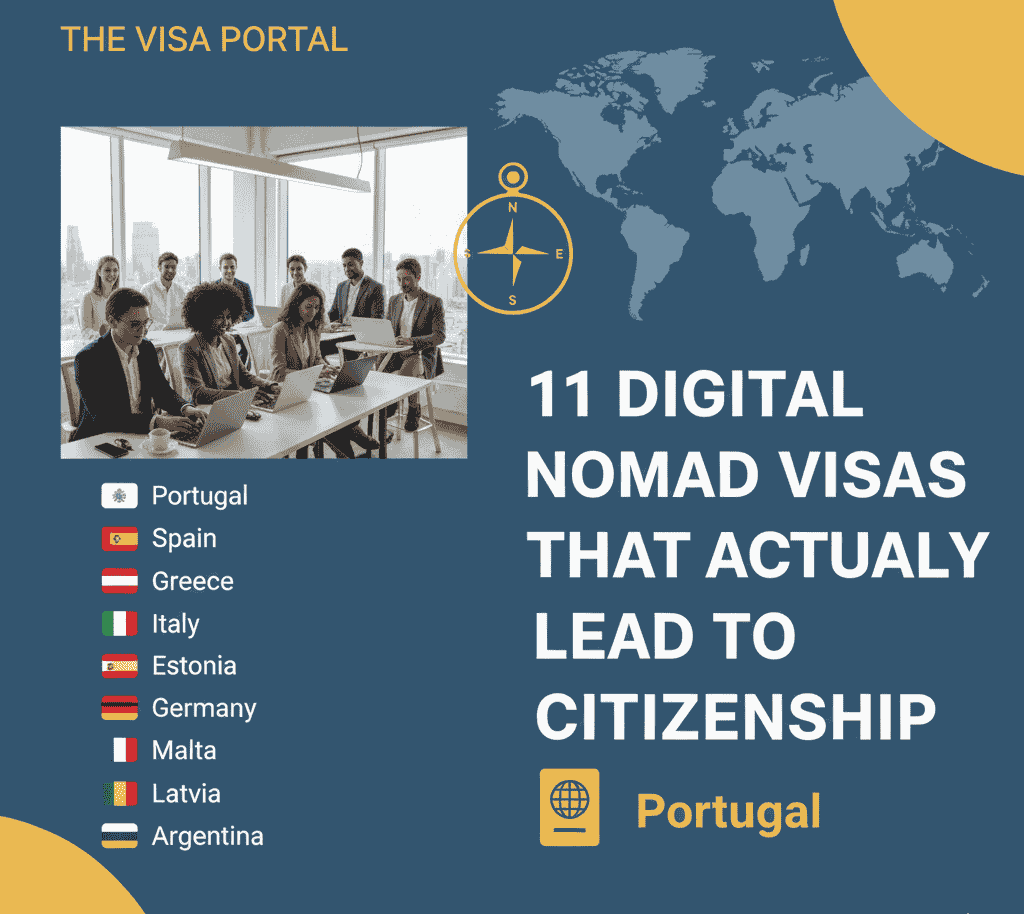
Digital nomad visas are no longer just short-term travel permits. In several countries, these visas can act as a gateway to permanent residency and eventual citizenship, provided you meet stay and integration requirements. If you’re a remote worker, freelancer, or online entrepreneur looking for a long-term future abroad, these countries offer real settlement opportunities.
Portugal Digital Nomad Visa
In October 2022, Portugal introduced the D8 Digital Nomad Visa, which created a special category for online workers to live and work in Portugal. Portugal has become one of the most popular places for digital nomads to live because of its easygoing way of life and its ease of long-term stays.
The program was created for self-employed professionals with continuing customer contacts and employees with contracts lasting at least a year.
It is one of the easier European settlement pathways for remote workers, fitting into Portugal’s current five-year residence-to-citizenship timeframe.
- Who can apply: Remote employees with a 1-year+ contract or self-employed professionals with ongoing foreign clients
- Where to apply: Portuguese consulate abroad or AIMA inside Portugal
- Length of stay: 1–2 years initially, renewable up to 5 years total. After 5 years of legal residence, applicants can apply for Portuguese permanent residency or citizenship.
- Visa cost: The visa cost is $75 for the visa application, plus an additional $90 for the residence permit.
- Financial requirement: Around €2,800/month (linked to minimum wage; updated yearly)
- Citizen Eligibility: After 5 years of legal residence, applicants can apply for Portuguese permanent residency or citizenship.
- Key condition: Income must come from a foreign employer or foreign clients. Basic Portuguese language knowledge is required.
Spain Digital Nomad Visa
Spain started offering the digital nomad visa in January 2023 as part of the Startup Law. With Spain’s digital nomad visa, those who work from home can live and work in the nation lawfully while making money from abroad. You can renew your visa and become a long-term resident.
The program allows an initial stay of up to 3 years; however, the time required to become a citizen varies widely from country to country. It also fits within Spain’s usual long-term residence and citizenship tracks.
- Who can apply: Remote employees and freelancers working for non-Spanish companies or clients
- Where to apply: Spanish consulate abroad or from within Spain with proof of remote work, qualifications, and health insurance
- Length of stay: Up to 3 years initially, extendable for 2 additional years(maximum 5 years)
- Financial requirement: Commonly referenced at €2,334 per month for single applicants; higher amounts apply in practice and for dependents
- Citizenship Eligibility: After 10 years of legal stay, digital nomads may become eligible for Spanish citizenship, or 2 years for many Latin American citizens.
- Visa Cost: The visa costs approximately $73 as a consular fee, plus an additional $80 for the NIE, bringing the total to around $153.
- Key condition: Local Spanish employment is restricted unless explicitly permitted under the visa
Greece Digital Nomad Visa
In 2021, Greece introduced the Digital Nomad Visa to attract freelancers and remote workers who clients outside Greece pay. In contrast to some other countries, Greece introduced a new visa type specifically for people who work from home.
The plan fits well with Greece’s traditional system for obtaining residence and citizenship, but it has slightly higher income requirements than other European options. Many people think that the visa is one of the easiest for digital nomads to get because Greece is beautiful, has a lavish lifestyle, and is welcoming.
Holders of the Greek digital nomad visa can live and work in Greece for 1 year, with the option to stay for up to 2 additional years. Digital nomads can have an excellent work-life balance in Greece because the pace is slow, the social scene is lively, and there are many ways to have fun.
- Where to apply: Apply to a Greek consulate, providing proof of remote work, stable foreign income, and valid health insurance.
- Who can apply: Remote employees or freelancers earning foreign-sourced income, with sufficient monthly income and valid health insurance.
- Length of stay: Issued for 1 year initially, with renewals under Greece’s residence system, commonly in 2-year extensions.
- Financial requirement: Minimum income of €3,500 per month, with higher thresholds for accompanying dependents.
- Citizenship Eligibility: Applicants may apply for Greek citizenship after 7 years of legal residence, provided they pass the required Greek language and cultural knowledge tests.
- Visa Cost: The visa application fee is approximately $79.
- Key condition: Employment must remain outside Greece, with income sourced from foreign employers or clients.
Estonia Digital Nomad Visa
Estonia became the first nation in the world to have an official visa program for digital nomads, making history. They developed their freelancer and digital nomad visa in 2020. It enables you to operate remotely while remaining in the nation.
- Who can apply: Remote employees working for a foreign employer or self-employed professionals with ongoing foreign clients
- Where to apply: Estonian embassy or consulate abroad
- Length of stay: Up to 1 year (short-term visa); extensions are limited.
- Financial requirement: Minimum €4,500 gross per month (average of the 6 months prior to application)
- Citizen Eligibility: After 8 years of legal residence, including permanent residency, digital nomads may qualify for Estonian citizenship.
- Visa Cost: The visa application fee is $85 approximately
- Key condition: Work must be performed remotely for a foreign employer or foreign-registered business.
Italy Digital Nomad Visa
Italy introduced the Digital Nomad Visa in April 2024. This visa made it official for highly skilled freelancers and remote workers who work for organizations outside of Italy to live and work in Italy. The visa requires proof of professional credentials and a minimum income of about €30,000 per year. It also grants you a one-year permit that you can renew every year. It lets those who work from home live like they do in the Mediterranean and gives them a choice of where to live. It also aligns with Italy’s “10-year naturalization timeline” and the EU’s long-term resident status framework. Italy also keeps track of other important visas, such as the “Intra-company visa” and “Self-employment” visas.
- Who can apply: Remote employees with a 1-year+ contract or self-employed professionals with an ongoing foreign client.
- Where to apply: Italian consulate abroad or via the immigration office (Questura) in Italy with proof of professional qualifications, accommodation, comprehensive health insurance, and ongoing contracts.
- Length of stay: Typically 1 year initially, renewable annually.
- Financial requirement: Minimum income requirement set by Italian authorities (often cited around €3,000/month).
- Citizen Eligibility: Continuous residence for 10 years can make you eligible for Italian citizenship, provided you meet income, tax, and integration requirements.
- Visa Cost: The visa application fee is $116 approximately.
- Key condition: Income must come from a foreign employer or foreign clients.
Germany Freelance & Digital Nomad Path
As remote employment became more common in the late 2010s, Germany’s freelance residency permit—which has been in place for decades—became the de facto path for digital nomads.
It’s a typical self-employment category that suits location-independent professionals well, unlike specially designed nomad visas.
Germany does not offer a traditional digital nomad visa but provides a Freelance visa, widely used by remote workers.
- Who can apply: Freelancers and remote workers from abroad.
- Where to apply: German consulate abroad or local Foreigners’ Office (Ausländerbehörde) in Germany, submitting client contracts or reference letters, health insurance, and proof of financial stability.
- Length of stay: 1–3 years initially, renewable
- Financial requirement: Sufficient income to support oneself (€2,500–€3,000/month)
- Citizen Eligibility: After 5 years of residence, applicants can apply for permanent residency, and after 8 years, they may qualify for German citizenship.
- Visa Cost: The visa application fee is$105 approximately.
- Key condition: Must maintain a foreign client base or self-employment.



Malta Digital Nomad Visa
In June 2021, the Malta digital nomad visa was introduced, enabling digital nomads to spend a whole year in Malta. Malta’s Nomad Residence Permit allows remote workers to live on the island while working for foreign companies. It can be renewed and later converted into other residency types.
Malta’s English-speaking environment, 5G connectivity, and tax-neutral status if income is taxed overseas are advantages for non-EU nationals.
- Who can apply: Remote employees or self-employed professionals with foreign income
- Where to apply: Maltese consulate abroad or Identity Malta Agency in Malta
- Length of stay: 1 year initially, renewable annually
- Financial requirement: Around €2,700/month
- Citizenship Eligibility: After 5 years of residency, digital nomads may become eligible for long-term residence, and later apply for citizenship under Maltese law.
- Visa Cost: The visa application fee is $316 approximately.
Key condition: Must work for foreign employer or clients
Latvia Digital Nomad Visa
In 2021, Latvia introduced the digital nomad visa, which is intended for remote workers who work for or contract with organizations in OECD nations.
Compared to other European choices, the program is less clear as a settlement route because it only offers two years of full validity with limited renewal. The visa is usually valid for only one year, but it can be renewed if the requirements are met. Digital nomads who want to live in the EU can choose this option because it can lead to long-term residency and citizenship in Latvia.
- Who can apply: Remote employees or self-employed professionals working for foreign companies or clients registered outside Latvia.
- Where to apply: Latvian embassy or consulate abroad, or the Office of Citizenship and Migration Affairs (OCMA) in Latvia.
- Length of stay: Up to 1 year initially, renewable depending on continued eligibility.
- Financial requirement: Around €3,000/month (subject to change and official confirmation).
- Citizenship Eligibility: Permanent residence after 5 years of legal stay; citizenship possible after 10 years, subject to language and integration tests.
- Visa Cost: The Latvia Digital Nomad Visa application fee is approximately €80.
- Key condition: Must maintain employment or self-employment with foreign employer or foreign clients only.
Bulgaria Digital Nomad Visa
Bulgaria started the Digital Nomad/Freelancer Program in 2025. It lets freelancers get a Type D Visa through an employment agency.
Bulgaria has a lot more to offer than Western Europe, like beautiful hills, historic charm, and beaches on the Black Sea. And, the cost of living is much lower Because of its growing technology sector and welcoming expat communities, Sofia is quickly becoming a place where people who work from home can live. Digital nomads love this country because of its delicious food and rich cultural history.
- Who can apply: Remote employees or self-employed professionals working for foreign employers or clients.
- Where to apply: Bulgarian consulate abroad or the Migration Directorate in Bulgaria
- Length of stay: Typically 1 year initially, renewable annually
- Financial requirement: No fixed statutory amount; applicants usually show income around €2,000–€2,500 per month, proving financial self-sufficiency
- Citizenship Eligibility: Permanent residence after 5 years of continuous legal stay; citizenship after 10 years (earlier in limited cases)
- Visa Cost: The total visa cost is approximately $60–100, including the visa application and freelance permit fees.
- Key notes: Bulgaria does not have a standalone “digital nomad visa,” but remote workers use long-term residence permits; income must remain foreign-sourced.
Argentina Digital Nomad Visa
With Argentina’s Digital Nomad Visa, remote workers and freelancers can live in the country and make money from other countries. It was created to draw in skilled workers from other countries and has a simple application process and low income requirements. One of the best things about it is that it has a fast path to citizenship. After just two years of legal residence, applicants can become eligible, making Argentina one of the fastest ways for digital nomads to become citizens.
- Who can apply: Remote employees or self-employed professionals with foreign income
- Where to apply: Argentine consulate abroad or Dirección Nacional de Migraciones in Argentina
- Length of stay: 1 year initially, renewable
- Financial requirement: Around USD 1,500/month
- Citizenship Eligibility: After 2 years of continuous legal residence, applicants may apply for Argentine citizenship, making it one of the fastest pathways globally.
- Visa Cost: The Argentina Digital Nomad Visa costs approximately $200 USD, though fees may vary slightly by consulate and nationality.
- Key condition: Must work for foreign employer or clients
Digital nomad visas are no longer just about flexibility and travel—they can be a strategic first step toward second citizenship. Countries like Portugal, Argentina, Germany, and Greece offer realistic and achievable long-term settlement options for remote workers.
Final Thought
If your goal is not only to work remotely but also to secure permanent residency and a powerful passport, choosing the right digital nomad destination can shape your future.


Leave a Reply